Confectionery Insights & News
Industry trends, private label manufacturing guides, and export knowledge from our Lahore workshop.
10 Tips for Sourcing Milk Chocolate Pralines?
Table of Contents
- Define Milk Chocolate Pralines: ≥25% Cocoa Solids Under EU Rules
- Specify Milk Ingredients: ≥14% Milk Solids and ≥3.5% Milk Fat
- Audit Suppliers Against BRCGS, IFS, HACCP, and Full Lot Traceability
- Compare MOQ, Pricing, Lead Times, and 12–18-Month Shelf-Life Data
- Approve Samples Using Tempering, Water Activity, Allergen, and Sensory Tests
- FAQS
- Conclusion
- Related Posts
Sourcing Milk Chocolate Pralines requires more than comparing prices and attractive packaging. A reliable buyer must examine cocoa content, filling quality, production controls, and supplier communication. The shell should have a clean snap, even gloss, and a smooth melt. The filling should taste balanced, not overly sweet or oily.
John Scharffenberger, co-founder of Scharffen Berger Chocolate Maker, once said, “Chocolate is a food, not a candy.” This perspective matters when evaluating pralines for retail, hospitality, or gifting. Milk Chocolate Pralines should show the character of their cocoa, milk, nuts, fruit, or caramel. Flavor should not hide weak ingredients.
Start with documented specifications. Ask about cocoa percentage, allergen controls, origin records, and storage conditions. Confirm whether the supplier uses real chocolate rather than a compound coating. Request samples from different production batches. A single perfect sample proves very little.
Check the praline’s center carefully. Is the ganache firm enough for transport? Does the caramel remain stable beside the shell? Are nut pieces fresh and evenly distributed? These small details affect customer trust. Packaging also deserves practical attention. Heat-resistant materials, batch codes, and clear shelf-life information can prevent costly surprises.
A supplier’s minimum order quantity and lead time must fit your sales pattern. Large volumes may reduce cost, but they can increase waste. That lesson is easy to overlook. Even experienced buyers sometimes focus too heavily on unit price. Taste, traceability, consistency, and honest problem-solving usually matter more over time. The following ten tips offer a practical framework for sourcing Milk Chocolate Pralines with fewer avoidable risks.
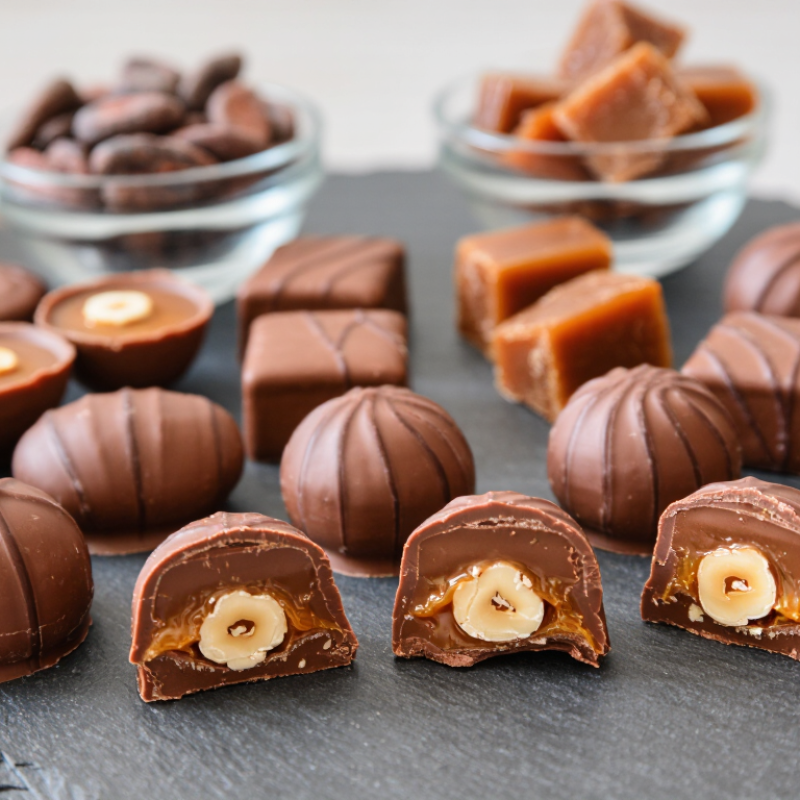
Define Milk Chocolate Pralines: ≥25% Cocoa Solids Under EU Rules
Milk chocolate pralines combine a chocolate shell with a filled centre.
Under EU rules, milk chocolate generally requires at least 25% total cocoa solids. It also needs minimum levels of milk solids and milk fat. Check the legal specification, not only the product name.
Sourcing depends on more than cocoa content.
Ask about cocoa origin, milk powder, allergens, and permitted additives.
I have found that glossy samples can still develop fat bloom later. My earlier checks were too visual.
Use a written tasting process.
Record snap, aroma, sweetness, melt, and filling consistency.
A supplier should explain variations between batches clearly. Ask for corrective actions when results differ. Do not rely on vague claims such as “premium” or “high cocoa.”
EU requirements may be implemented through national rules, so confirm details with a qualified compliance professional. Pralines are small, but their specifications are not.
Specify Milk Ingredients: ≥14% Milk Solids and ≥3.5% Milk Fat
10 Tips for Sourcing Milk Chocolate Pralines?
Specify Milk Ingredients: ≥14% Milk Solids and ≥3.5% Milk Fat
When sourcing milk chocolate pralines, define the milk ingredient specification before comparing prices. Request at least 14% milk solids and 3.5% milk fat in the finished chocolate formula. These levels support a creamy mouthfeel, gentle dairy aroma, and balanced sweetness. Ask suppliers whether their figures refer to the chocolate mass or the complete praline. That detail can change the result.
Request a current specification sheet, ingredient declaration, and certificate of analysis for every production batch. Check milk solids, milk fat, moisture, particle size, and microbiological results. A reliable supplier should explain the testing method and sampling plan. Keep a retained sample from each delivery. Taste it at room temperature, then inspect the shell after a week. Small details matter. A thick shell may hide a weak filling.
During trials, compare pralines made with skim milk powder, whole milk powder, or concentrated dairy ingredients. Each option affects flavor, viscosity, color, and storage behavior. I once focused too heavily on the stated milk fat level and overlooked the filling’s water activity. The pralines tasted rich but softened too quickly. That mistake still influences my sourcing checklist. Confirm how the supplier controls heat exposure, blending time, and storage temperature. Also verify allergen controls and traceability records. If the specification seems unclear, pause the order and request written clarification. A lower quote is not useful when the batch lacks consistent dairy character.
10 Tips for Sourcing Milk Chocolate Pralines
Specify milk ingredients clearly: milk chocolate should contain at least 14% milk solids and 3.5% milk fat. These quantitative benchmarks are based on Codex guidance for milk chocolate.
The chart compares key minimum composition benchmarks commonly used when reviewing milk chocolate specifications. Ask suppliers for a current product specification, ingredient statement, certificate of analysis, allergen declaration, and testing method before approval. Confirm that the finished praline, not only the couverture, meets your requirements.
- Specify at least 14% milk solids.
- Specify at least 3.5% milk fat.
- Confirm at least 25% total cocoa solids for the milk chocolate component.
- Request the full ingredient declaration and formulation range.
- Verify milk origin, processing conditions, and traceability.
- Check allergen controls for milk and possible cross-contact.
- Review cocoa butter, cocoa mass, sugar, and emulsifier specifications.
- Set sensory requirements for flavor, color, snap, and melt.
- Confirm praline filling stability, shelf life, and storage conditions.
- Approve production samples and verify every batch with a certificate of analysis.
Reference: Codex Standard for Chocolate and Chocolate Products (CXS 87-1981). Values shown are minimum benchmarks for milk chocolate composition and should be checked against the applicable market regulations.
Audit Suppliers Against BRCGS, IFS, HACCP, and Full Lot Traceability
When sourcing milk chocolate pralines, audit the supplier’s food safety system before judging appearance or price. Request current BRCGS or IFS certification, including the audited site, product scope, expiry date, and certification status. A certificate alone is not enough. Review the latest audit report and unresolved corrective actions. Serious findings involving allergens, hygiene, or foreign materials deserve clear evidence of closure.
Check that the supplier’s HACCP plan covers chocolate tempering, filled pralines, cooling, storage, and packing. Ask how they control milk, nuts, soy, and cross-contact risks. Walk through production records if possible. Look for practical details, such as calibrated thermometers, sealed ingredient containers, and cleaning checks between recipes. Small details matter. However, audits can create false confidence. I once focused too heavily on paperwork and overlooked inconsistent lot labels during a warehouse visit.
Full lot traceability should be tested, not merely promised. Ask the supplier to trace one finished praline lot back to cocoa, dairy ingredients, fillings, packaging, and production records. Then request a forward trace to every customer shipment. A mock recall should produce accurate results quickly, including quantities received, used, held, and dispatched. Review supplier approval, complaint trends, shelf-life validation, and transport temperature records. If records are handwritten, assess their legibility and review controls carefully. Reliable sourcing depends on evidence that still works on a busy production day.
| No. | Sourcing Tip | Audit Dimension | Evidence to Request | Praline-Specific Risk Covered | Verification Method | Recommended Supplier Decision Rule |
|---|---|---|---|---|---|---|
| 1 | Confirm the food-safety certification scope | BRCGS Food Safety Issue 9 or IFS Food Version 8 certification must cover the actual manufacturing site and the relevant product category. | Current certificate, certification scope, site address, audit date, expiry date, announced or unannounced audit status, and publicly verifiable certificate reference where available. | A valid certificate for another site or product category does not demonstrate control of milk chocolate pralines. | Check the certificate directly with the certification body and compare the scope with the proposed production line. | Pass only when scope matches |
| 2 | Audit the HACCP system, not just the certificate | The supplier should maintain a documented HACCP plan based on Codex principles, including hazard analysis, critical limits, monitoring, corrective actions, and verification. | Product flow diagram, hazard analysis, CCP or preventive-control justification, monitoring records, deviation reports, and annual HACCP review. | Undeclared allergens, microbiological contamination, foreign material, incorrect storage conditions, and ineffective process controls. | Trace one finished batch from ingredient receipt through tempering, filling, cooling, packing, release, and dispatch. | No unexplained gaps in the hazard analysis |
| 3 | Verify allergen management for milk and other ingredients | Milk is a major allergen in many jurisdictions. The audit should cover allergen mapping, segregation, label review, cleaning validation, changeover control, and rework management. | Allergen matrix, approved label artwork, validated cleaning records, swab or protein-test results where applicable, line-clearance records, and rework procedures. | Milk, soy lecithin, nuts, peanuts, wheat, egg, or other allergens may be present in chocolate, fillings, inclusions, or shared equipment. | Compare the recipe, specification, allergen statement, packaging artwork, and production records for one selected lot. | Label and recipe must agree |
| 4 | Set measurable product specifications | The purchase specification should define composition, physical attributes, microbiological criteria, chemical limits, packaging, shelf life, and storage conditions. | Signed product specification, ingredient declaration, nutrition data, allergen statement, target piece weight, dimensions, cocoa and milk-solids information where relevant, and shelf-life basis. | Inconsistent texture, bloom, filling leakage, incorrect net weight, short shelf life, and non-compliance with destination-market labeling requirements. | Approve a pre-production sample and verify the first commercial lot against the agreed specification. | Use written limits, not verbal expectations |
| 5 | Check raw-material approval and authenticity controls | Cocoa products, milk powders, fats, nuts, fillings, emulsifiers, colors, and packaging materials should come from approved suppliers with defined acceptance criteria. | Approved-supplier list, raw-material specifications, certificates of analysis where risk-based, incoming inspection records, authenticity or substitution assessments, and nonconformance records. | Adulteration, undeclared substitutions, rancid fats, contaminated nuts, incorrect allergen declarations, and variable chocolate viscosity. | Select high-risk materials and trace each one to its supplier lot, receiving record, test result, and production batch. | High-risk materials require documented controls |
| 6 | Test environmental and microbiological controls | The supplier should use a risk-based environmental monitoring and finished-product testing program appropriate to the product, process, and facility zoning. | Environmental monitoring plan, sampling map, trend reports, finished-product test results, laboratory accreditation details where applicable, and corrective actions. | Post-process contamination, contamination from personnel or equipment, and deterioration of cream, ganache, or other moist fillings. | Review at least twelve months of trends and investigate recurring positives, out-of-specification results, or repeated corrective actions. | Trend control is more important than one isolated result |
| 7 | Validate temperature and humidity controls | Storage and transport conditions should be defined according to the recipe and packaging. Chocolate products commonly require protection from excessive heat, moisture, and temperature fluctuation. | Product storage specification, warehouse temperature and humidity logs, calibration records, transport requirements, excursion procedure, and data-logger records when used. | Fat or sugar bloom, condensation, loss of gloss, texture changes, packaging damage, and reduced shelf-life performance. | Conduct a seasonal logistics review and inspect a shipment using calibrated temperature or humidity monitoring where risk justifies it. | Approve only against defined excursion limits |
| 8 | Demand complete lot traceability | The supplier should identify one step back for ingredients and packaging and one step forward for customers and dispatches, with quantities that reconcile. | Ingredient lot numbers, packaging lot numbers, production date, batch code, quantities used, finished-lot quantity, warehouse records, customer dispatch records, and rework links. | Slow or incomplete withdrawals, inability to identify affected pralines, and excessive product destruction during a recall. | Perform a documented mock trace or mock recall from a finished-product code to all ingredient lots and forward customers. | 100% quantity and lot reconciliation |
| 9 | Evaluate corrective-action performance | Audit findings should be managed through root-cause analysis, containment, corrective action, responsible ownership, due dates, and effectiveness checks. | Recent audit reports, nonconformance log, customer complaints, recall history, root-cause analysis, corrective-action evidence, and closure verification. | Repeated failures such as incorrect coding, damaged packaging, allergen-label errors, poor cleaning, or temperature excursions. | Compare repeated findings over the previous twelve months and verify whether actions eliminated the underlying cause. | Escalate repeated or overdue critical actions |
| 10 | Use a risk-based approval and review scorecard | Combine certification status, HACCP performance, allergen controls, traceability, product quality, capacity, logistics, and business continuity into one documented decision. | Completed supplier questionnaire, audit scorecard, approved-supplier status, insurance or continuity information where required, capacity confirmation, and review schedule. | Over-reliance on certification while overlooking supply disruption, quality instability, weak traceability, or unresolved food-safety risks. | Reassess at least annually and immediately after a serious incident, major process change, certification lapse, or significant complaint trend. | Approve, conditionally approve, or reject with documented rationale |
Audit note: Certification demonstrates conformity to the applicable scheme at the audited site and time; it does not replace buyer-specific due diligence, product testing, specification approval, or lot-traceability verification.
Compare MOQ, Pricing, Lead Times, and 12–18-Month Shelf-Life Data
10 Tips for Sourcing Milk Chocolate Pralines
Compare MOQ, Pricing, Lead Times, and 12–18-Month Shelf-Life Data
Tip 1: Compare MOQ by finished units, not kilograms. Tip 2: Request prices at three volume levels. Cocoa costs remain volatile. The International Cocoa Organization’s 2023/24 statistics reported a global cocoa deficit of about 439,000 tonnes. That pressure can change quotations quickly. Tip 3: Separate chocolate, filling, packaging, and freight costs. Tip 4: Ask whether tooling or setup fees are included. A low quote may hide expensive cartons or molds.
Tip 5: Record standard and expedited lead times. Tip 6: Confirm production slots before approving artwork. Eight weeks may become twelve during peak seasons. Tip 7: Require a written tolerance for delivery dates. Tip 8: Request pilot samples from the actual production line. Small batches can look better than factory output. This is an easy mistake to miss. Tip 9: Demand shelf-life evidence covering 0, 3, 6, 9, 12, and 18 months. Include sensory scores, moisture migration, fat bloom, texture, and microbiological results. Published food-science research consistently links unstable storage temperatures with bloom and texture loss.
Tip 10: Check the storage conditions behind every 12–18-month claim. Ask for data at 18–22°C and realistic humidity levels. Codex food-labelling principles require shelf-life information to be supported by product evidence. I would not trust a glossy certificate without raw test records. Keep retained samples from each lot. Review them at three-month intervals. Pralines are sensitive products, and packaging performance can disappoint before the chocolate visibly changes.
Approve Samples Using Tempering, Water Activity, Allergen, and Sensory Tests
Before approving milk chocolate praline samples, I check tempering performance in a controlled workspace. The shell should melt evenly, set with a clean snap, and show a steady gloss after 24 hours. I record the chocolate temperature, room temperature, and cooling time. Small changes can create visible bloom. Keep records.
A water activity test helps estimate texture stability and microbial risk. I request results from a calibrated meter, not a rough moisture reading. The filling should be tested separately from the shell when possible. I also review the ingredient statement and allergen controls with the supplier. Shared equipment, rework, and cleaning procedures deserve clear answers. Paperwork alone is not enough.
Sensory testing should use several trained tasters and identical sample portions. We assess cocoa aroma, dairy notes, sweetness, bitterness, shell thickness, filling texture, and aftertaste. Taste it twice. My first approval once focused too much on glossy shells, while the filling became grainy after storage. That mistake changed my process. I now retest samples after chilled and room-temperature holding. A simple score sheet improves consistency, but it cannot replace honest discussion. If one sample feels unusually waxy or leaves a harsh aftertaste, I pause approval and ask for a revised batch. Reliable sourcing depends on repeatable evidence, not one attractive sample.
FAQS
Request at least 14% milk solids and 3.5% milk fat in the finished chocolate formula. These levels support creaminess and gentle dairy aroma. Ask whether the figures apply to the chocolate mass or the complete praline. That distinction matters.
Request a current specification sheet, ingredient declaration, and certificate of analysis. Review milk solids, milk fat, moisture, particle size, and microbiological results. Ask about testing methods and sampling plans. Keep one retained sample from every delivery.
Taste each sample at room temperature. Inspect the shell after one week. A thick shell may hide a weak filling. Check for gloss, texture changes, graininess, and unusual softening.
Compare skim milk powder, whole milk powder, and concentrated dairy ingredients. Each option affects flavor, viscosity, color, and storage behavior. The richest option is not always the most stable. I once overlooked filling water activity.
Water activity helps estimate texture stability and microbial risk. Request results from a calibrated meter. Test the filling separately from the shell when possible. Moisture readings alone may not explain softening.
The shell should melt evenly, set with a clean snap, and retain gloss after 24 hours. Record chocolate temperature, room temperature, and cooling time. Small temperature changes can create visible bloom. Keep records.
Use several trained tasters and identical sample portions. Assess cocoa aroma, dairy notes, sweetness, bitterness, shell thickness, filling texture, and aftertaste. Taste twice. Retest samples after chilled and room-temperature holding.
Confirm heat exposure, blending time, storage temperature, allergen controls, and traceability records. Ask about shared equipment, rework, and cleaning procedures. Paperwork alone is not enough. A harsh aftertaste deserves another review.
Conclusion
Sourcing Milk Chocolate Pralines requires a clear understanding of product standards, supplier capabilities, and quality expectations. Under EU rules, the product should contain at least 25% cocoa solids, while milk ingredients should provide a minimum of 14% milk solids and 3.5% milk fat. Buyers should evaluate suppliers through documented audits covering BRCGS, IFS, HACCP, hygiene controls, allergen management, and complete lot traceability. These checks help confirm that production processes are consistent, controlled, and suitable for long-term commercial supply.
Before approval, compare minimum order quantities, pricing, lead times, packaging options, and available shelf-life data, ideally covering 12 to 18 months. Samples should be assessed through practical tempering trials, water activity testing, allergen verification, and structured sensory reviews for flavor, texture, appearance, and filling stability. A supplier should only be selected when its technical documentation, sample performance, production reliability, and commercial terms meet the intended market requirements.

Blog Tags: